
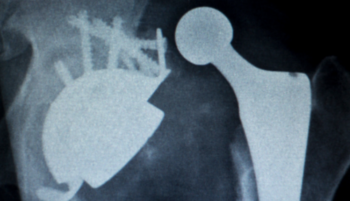
Evaluating the Role of Bearing Diameter in Dislocations After Total Hip Arthroplasty
Does maximizing bearing diameter markedly lower dislocations among primary total hip arthroplasty (THA) patients?
That was the question asked by researchers from NYU Langone Health, led by Matthew S. Hepinstall, MD. The study received the AAHKS Clinical Research Award, given annually at the annual meeting of the American Association of Hip & Knee Surgeons in recognition of outstanding clinical research in the field of hip and knee arthroplasty.
The researchers reviewed data on all patients who underwent fixed-bearing THA at NYU Langone Health between 2016-2022. They noted which patients received the largest bearing available from any manufacturer for the acetabular diameter. Larger cups were excluded.
While controlling for confounders, the researchers performed multivariate analyses using least-absolute-shrinkage-and-selection-operator (LASSO) logistic regression to explore the association between maximized bearing diameter and 90-day dislocation risk.
Bearing diameter was maximized in 835 of 8607 patients, whereas 7309 patients received the second-largest bearing available. There were 79 dislocations; however, none occurred with maximized bearing diameters. Dislocation risk also varied with intraoperative technology use, surgical approach, and liner geometry.
In a sub-analysis of 4185 patients with smaller bearings who underwent THA by the posterior approach, liner geometry did not impact dislocation odds. Receiving the second-largest available bearing also did not demonstrably reduce dislocation odds compared with smaller bearings.
“For a surgeon looking to reduce their total hip arthroplasty dislocation rate, we found one to-do [for] tomorrow, without buying a new tool or learning a new approach,” said Dr. Hepinstall, senior author on the paper.
“Utilizing the largest available bearing, within 14 millimeters of the cup diameter, is associated with markedly reduced odds of dislocation. Advanced technology and stable surgical approaches mattered also, but bearing diameter had the largest effect size.”
Source
Wang E, von Treuheim TD, Di Gangi C, Schwarzkopf Rn, Meftah M, Hepinstall MS. Maximizing Bearing Diameter Markedly Lowers Dislocations in Primary Total Hip Arthroplasty. Presented at the annual meeting of the American Association of Hip and Knee Surgeons, October 23-26, 2025, in Dallas, Texas.